Invoice Late Payment Fee Wording: Templates, Examples & Contract Clauses for Small Businesses
You’ve delivered excellent work, sent a professional invoice, and ... crickets. Two weeks past the due date, you’re wondering if you should charge a late fee, and more importantly, how to word it without losing a valuable client. You’re not alone. For small businesses and freelancers, managing cash flow is a constant challenge, and late payments are a major disruptor. In fact, a staggering 55% of all B2B invoices in the US were paid late in 2023, creating significant financial strain on businesses just like yours.
Chasing overdue payments is frustrating and time-consuming. It pulls you away from the work you love and forces you into the uncomfortable role of a debt collector. But what if you could significantly reduce late payments with a few simple, proactive steps? The secret lies in clear, professional, and legally sound communication. It’s not about being aggressive but about setting clear expectations from the very beginning.
This clear guide provides everything you need to master the art of late payment fee wording. We’ll go beyond simple templates to give you the legal knowledge, psychological insights, and practical tools to protect your cash flow while preserving your client relationships. By the end of this post, you will have:
- A clear understanding of the legal requirements for late fees.
- A library of 10+ copy-paste templates for invoices, contracts, and emails.
- A state-by-state guide to maximum late fee regulations.
- Psychology-backed strategies for wording that gets you paid faster.
- A step-by-step guide to implementing your own late fee policy.
Let’s transform your invoicing process from a source of stress into a streamlined, professional system that ensures you get paid on time, every time.
What Are Late Payment Fees and Why They Matter
Before we dig into templates and legal clauses, it’s important to understand the fundamentals of late payment fees. These fees are not so much about penalizing clients but a vital tool for managing your cash flow, compensating for administrative costs, and reinforcing the value of your work. When implemented correctly, they act as a powerful incentive for timely payment.
The Difference Between Late Fees and Interest
While often used interchangeably, "late fees" and "interest" are distinct financial penalties. Understanding the difference is key to creating a clear and legally compliant policy.
| Type | Description | How It Works | Best For |
| Flat Late Fee | A one-time, fixed charge applied as soon as an invoice becomes overdue. | A $1,000 invoice with a $50 late fee becomes $1,050 the day after it’s due. | Simplicity and clarity. It’s easy for clients to understand and for you to apply. |
| Simple Interest | A percentage-based fee calculated on the original overdue amount, accruing over time. | A $1,000 invoice at 1.5% monthly interest accrues $15 in fees for each month it remains unpaid. | Ongoing incentive to pay. The longer the client waits, the more they owe. |
| Compound Interest | A percentage-based fee calculated on the outstanding balance, including previously accrued interest. | A $1,000 invoice at 1.5% monthly interest accrues $15 the first month. The second month, interest is charged on $1,015. | Maximum financial penalty, but it’s legally restricted in many areas and can be perceived as aggressive. |
For most small businesses, a flat late fee or simple interest is the most straightforward and professional approach. Compound interest can be complex to calculate and may not be legally enforceable in all jurisdictions for B2B transactions.
Why Proper Wording Is Legally Critical
Here’s the most important rule: you cannot charge a late fee unless the terms are clearly stated in your original contract or invoice. You cannot retroactively decide to add a fee after a payment is already late. The language you use is not simply for being polite; it forms the legal basis for your right to collect these fees. Vague, ambiguous, or overly aggressive wording can render your policy unenforceable and even damage your professional reputation.
Your late payment clause must be a clear, mutually agreed-upon term of your business relationship. This protects both you and your client by ensuring there are no surprises. We’ll cover the specific legal requirements in the next section.
The Psychology Behind Effective Late Fee Wording
Why do some reminders get ignored while others get immediate results? The answer lies in human psychology. Effective late fee wording leverages a few key principles to gently nudge clients toward payment without causing offense.
One of the most powerful is loss aversion, the principle that people are more motivated to avoid a loss than to achieve a gain. Instead of framing a late fee as a punishment, frame it as an avoidable consequence. Language like, “You can avoid a late fee by submitting payment before [Date]” is more effective than “A late fee will be charged if you are late.”
Clarity is also paramount. Clients often delay payment due to confusion, not malice. If they don’t understand the invoice, need an internal approval, or are unsure how to pay, they will procrastinate. Your wording should be direct, simple, and action-oriented. Replace passive phrases like “Your prompt payment would be appreciated” with a clear call to action like, “Please submit payment by [Date] to keep your account in good standing.”
Legal Requirements for Late Payment Fees
Navigating the legal landscape of late fees can seem daunting, but it’s manageable once you understand the key principles. While you should always consult with a legal professional to ensure full compliance, this section provides a strong foundation for creating a legally sound policy.
Federal and State Regulations
At the federal level, there is no single law that dictates maximum late fees for B2B transactions. The Prompt Payment Act requires federal agencies to pay their bills on time, but it does not apply to private businesses. This means that late fee regulations are primarily determined at the state level.
More than 30 states have no specific limit on how much you can charge for late payment on a commercial invoice, but there’s a universal catch: the fee must be “reasonable.” A reasonable fee is one that fairly compensates you for the administrative costs and financial impact of the late payment, rather than one that is purely punitive.
State-by-State Maximum Late Fees
While many states are flexible, several have specific limits on late fees or interest rates. It’s important to know the laws in your state and your client’s state. Here are the regulations for a few key states to give you an idea of the variations:
| State | Maximum Late Fee / Interest Rate | Notes |
| California | 10% per year unless a different rate is specified in a contract. | The fee must be reasonable and related to the actual damages suffered. |
| Florida | 18% per year (1.5% per month). | A written agreement is required to charge a higher rate. |
| New York | 9% per year on judgments, but up to 16% per year can be charged on loans. | Commercial late fees are generally considered a matter of contract. |
| Texas | 6% per year if no rate is agreed upon in a contract. | Parties can agree to a higher rate, but it must be reasonable. |
| Delaware | 5% of the overdue balance per month. | The terms must be clearly stated in the invoice or contract. |
Disclaimer: This information is for educational purposes only and is not legal advice. Always consult with a qualified legal professional for guidance specific to your situation.
What Makes a Late Fee “Reasonable”?
In states without a specific cap, how do you determine a "reasonable" fee? Courts generally consider a few factors:
- Industry Standards: What is the typical late fee in your industry? For most, this is 1-2% per month.
- Actual Damages: Does the fee reflect the actual cost you incur from the late payment (e.g., administrative time, lost interest)?
- Invoice Amount: The fee should be proportional to the total invoice value.
- Clarity of the Agreement: Was the fee clearly and prominently disclosed to the client before they agreed to the work?
A safe bet for most businesses is to charge 1.5% per month on the outstanding balance. This is a widely accepted industry standard and is generally considered reasonable in most jurisdictions.
Your Complete Late Payment Fee Policy (Copy-Paste Ready)
Now, let’s put it all together. A clear late payment fee policy should be a standard part of your client contract or service agreement. This ensures your client has seen and agreed to the terms before any work begins. The following template is a great starting point. Be sure to have it reviewed by your legal counsel.
Late Payment Policy
1. Payment Due Dates: All invoices are due and payable within [Number] days of receipt. The due date will be clearly stated on each invoice.
2. Grace Period: A grace period of [Number] days will be granted from the invoice due date before any late fees are assessed. We believe in maintaining a positive relationship and understand that occasional delays can happen.
3. Late Fee Assessment: If payment is not received within the grace period, a late fee of [Percentage]% of the outstanding invoice balance will be assessed per month, or a flat fee of $[Amount], whichever is greater. This fee is intended to cover the administrative costs and financial impact of the overdue payment.
4. Service Interruption: For ongoing services or retainer agreements, we reserve the right to suspend services if an invoice remains unpaid for more than [Number] days past the due date. Services will be reinstated upon receipt of the full outstanding balance, including any accrued late fees.
5. Collections: If an invoice remains unpaid for [Number] days, we reserve the right to refer the debt to a third-party collections agency or pursue legal action. The client will be responsible for all costs associated with the collection of the debt, including but not limited to legal fees, court costs, and collection agency fees.
6. Disputes: Any disputes regarding an invoice must be submitted in writing within [Number] days of the invoice date. If a dispute is not raised within this timeframe, the invoice will be deemed correct and payable in full.
Where to Display This Policy:
- In Your Contract: This is the most important place. It should be a standard clause in every service agreement or client contract.
- On Your Website: Include it on your "Terms of Service" or "FAQ" page.
- In Your Proposal: Mention your payment terms in your initial proposal so there are no surprises.
- On Your Invoices: A brief reminder of your policy should be included on every invoice.
10+ Late Payment Fee Wording Templates for Every Scenario
Your late payment fee wording needs to be adapted to the context. A formal contract requires different language than a friendly email reminder. Here is a library of templates you can use for various situations.
Template 1: Basic Invoice Payment Terms
Use this on the bottom of every invoice.
"Payment is due within 30 days. A late fee of 1.5% per month will be applied to all overdue balances. Thank you for your business!"
Template 2: Detailed Contract Clause
Use this in your standard service agreement.
"Client agrees to pay all invoices within thirty (30) days of receipt. Invoices unpaid after thirty (30) days will be subject to a late fee of 1.5% of the outstanding balance per month. A grace period of five (5) days will be granted before late fees are assessed."
Template 3: Freelancer-Friendly Version
A less formal option for independent contractors.
"To keep things running smoothly, please submit payment within 21 days. A 1.5% monthly late fee helps cover administrative costs for overdue accounts. I appreciate your timely payment!"
Template 4: B2B Service Agreement
A more corporate tone for business-to-business services.
"All payments are due Net 30. Balances not paid within thirty (30) days of the invoice date are subject to a service charge of 1.5% per month. In the event of default, the client agrees to pay all costs of collection, including reasonable attorney’s fees."
Template 5: Consulting Contract Clause
For professional services and retainers.
"Invoices for consulting services are due upon receipt. A monthly late fee of 1.5% will be applied to any unpaid balance after 15 days. For retainer agreements, services may be paused if the account is more than 30 days in arrears."
Template 6: Agency-Client Agreement
For project-based work with multiple deliverables.
"Payment for each project milestone is due within 15 days of invoice receipt. A late fee of $50 will be applied to any milestone payment that is more than 7 days overdue, with an additional 1.5% monthly interest on the outstanding project balance thereafter."
Template 7: SaaS/Subscription Services
For recurring revenue models.
"Your subscription will automatically renew on the 1st of each month. If payment fails, we will attempt to charge the card on file for 7 days. If payment is not successful after 7 days, your account will be suspended. A reactivation fee of $25 may apply."
Template 8: Construction/Trade Services
For industries with specific legal protections.
"Payment is due within 30 days. Per state law, unpaid balances may be subject to a mechanic’s lien. A late fee of 1.5% per month will be charged on all overdue amounts."
Template 9: Hybrid Approach (Flat Fee + Interest)
An escalating approach to encourage payment.
"A one-time late fee of $25 will be applied to invoices that are 15 days past due. An additional 1.5% monthly interest will be charged on the outstanding balance for every 30 days the invoice remains unpaid."
Template 10: International Clients
Addressing cross-border complexities.
"All payments are to be made in USD. Invoices are due within 30 days. A late payment fee of 1.5% per month (simple interest) will be applied to overdue balances. Please note that compound interest is not applied."
Email Templates for Late Payment Reminders
How you ask for payment is just as important as your official policy. A well-timed, professionally worded email can often resolve an overdue payment without needing to enforce a late fee. Here are templates for every stage of the process.
Pre-Due Date Reminder (Friendly)
Send 3-5 days before the due date.
Subject: Friendly Reminder: Invoice #[Invoice Number] is due soon
Hi [Client Name],
This is just a friendly reminder that invoice #[Invoice Number] for $[Amount] is due on [Due Date]. You can view and pay the invoice here: [Link to Invoice]
Please let me know if you have any questions.
Thanks,
[Your Name]
Payment Due Today Reminder
Send on the due date.
Subject: Invoice #[Invoice Number] is due today
Hi [Client Name],
This is a reminder that payment for invoice #[Invoice Number] for $[Amount] is due today. You can make a payment here: [Link to Invoice]
As a reminder, our payment terms are [Net 15/30/etc.]. To avoid a late fee of [Fee Amount], please submit payment by the end of the day.
Best,
[Your Name]
1-7 Days Overdue (Gentle)
Assume good faith and check if there’s a problem.
Subject: Invoice #[Invoice Number] is now overdue
Hi [Client Name],
I’m writing to follow up on invoice #[Invoice Number], which was due on [Due Date]. It is now [Number] days overdue.
I’ve attached a copy for your convenience. Could you please let me know when we can expect payment? If you’ve already sent it, please disregard this message.
Thanks,
[Your Name]
8-14 Days Overdue (Firm)
Mention the late fee policy directly.
Subject: URGENT: Invoice #[Invoice Number] is Overdue
Hi [Client Name],
My records indicate that invoice #[Invoice Number] is now more than a week overdue. The original due date was [Due Date].
Per our agreement, a late fee of [Fee Amount] will be applied if the invoice remains unpaid by [Date, e.g., end of this week]. Please submit payment promptly to avoid additional charges. You can pay online here: [Link to Invoice]
Please let me know if there is an issue I should be aware of.
Sincerely,
[Your Name]
15-30 Days Overdue (Formal Notice)
The late fee has now been applied.
Subject: Second Notice: Overdue Invoice #[Invoice Number]
Dear [Client Name],
This is our second notice regarding invoice #[Invoice Number] for $[Original Amount], which was due on [Due Date]. The invoice is now [Number] days overdue.
In accordance with our payment terms, a late fee of $[Late Fee Amount] has been added to your outstanding balance. The new total amount due is $[New Total].
Please remit payment in full by [New Due Date] to prevent further fees and potential service interruption.
You can pay the full amount here: [Link to Invoice]
Regards,
[Your Name]
30+ Days Overdue (Final Notice)
This is the last step before escalating to collections.
Subject: FINAL NOTICE: Invoice #[Invoice Number] is 30+ Days Overdue
[Client Name],
This is our final notice regarding invoice #[Invoice Number]. Despite our previous reminders, your payment of $[New Total] is now more than 30 days delinquent.
If this outstanding balance is not paid in full within the next 5 business days, we will be forced to suspend your services and refer your account to a collections agency.
We wish to avoid this, so please contact us immediately to arrange payment.
Pay now to keep your account in good standing: [Link to Invoice]
[Your Name]
The Decision Tree: When to Enforce Late Fees
Having a late fee policy is one thing; knowing when to enforce it is another. Applying a fee can sometimes feel confrontational, but failing to do so can signal that your payment terms are not serious. This decision tree can help you navigate the choice with confidence.
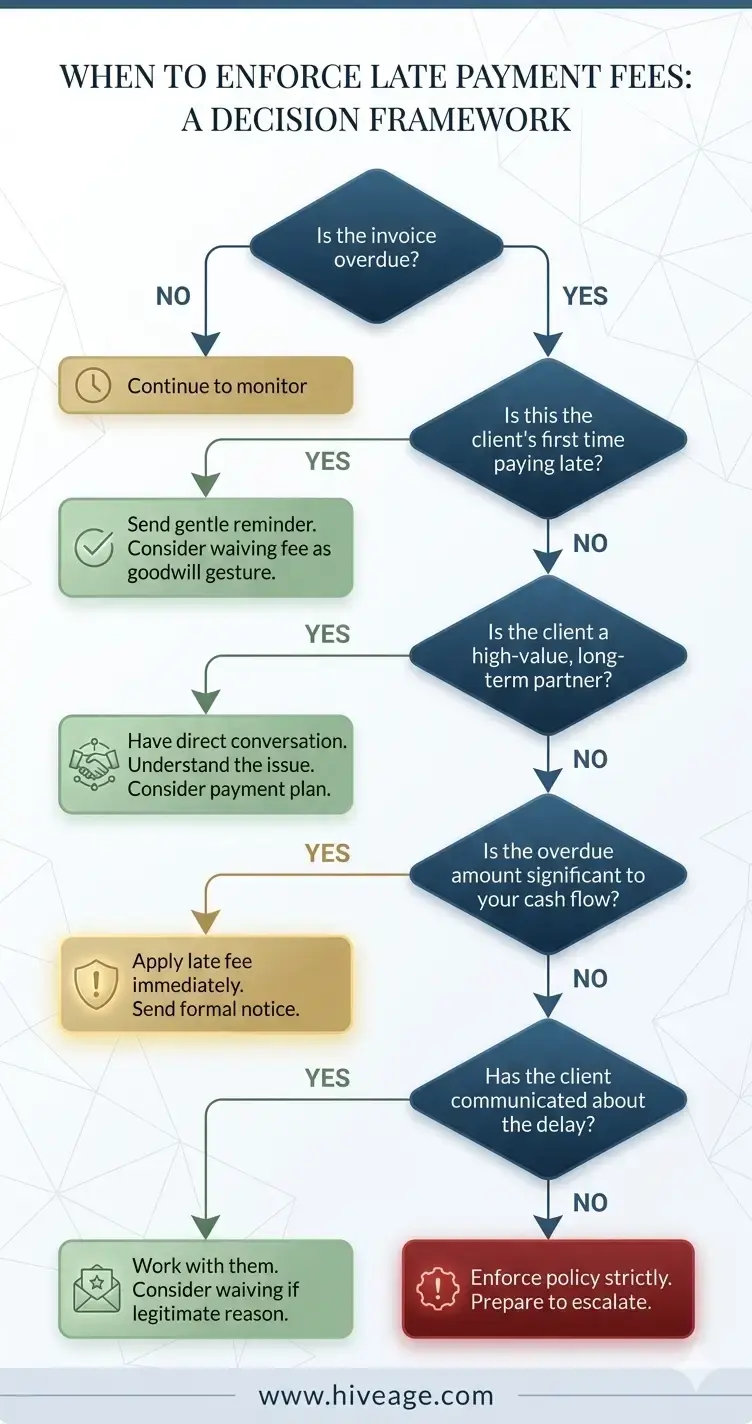
This framework helps you make consistent, professional decisions that balance the need to get paid with the desire to maintain positive client relationships.
What to Do When Clients Dispute Late Fees
Even with a clear policy, you may occasionally face pushback. How you handle these disputes is critical. The key is to remain professional, rely on your documentation, and know when to stand firm.
Common Objections and How to Respond:
“I never agreed to this.”
Response: “I understand your concern. The late fee policy was included in section [Number] of the contract you signed on [Date]. I’ve attached a copy for your reference.”
“This seems excessive.”
Response: “Our late fee is 1.5% per month, which is a standard rate in our industry and is intended to cover the administrative costs of managing overdue accounts. It’s also in line with the state’s guidelines for reasonable fees.”
“I didn’t receive the invoice.”
Response: “I’m sorry to hear that. I’ve confirmed it was sent to [Email Address] on [Date]. I’ve just resent it to you. To avoid this in the future, could you please confirm the best email address for invoices?”
“There was a problem with the work.”
Response: “This is the first I’m hearing of an issue. Our policy is that all disputes must be raised within 15 days of the invoice date. Let’s schedule a call to discuss your concerns, but please note that the invoice is still due.”
In these situations, documentation is your best friend. Always keep records of signed contracts, email communications, and delivery confirmations. If a dispute becomes serious, you’ll need this evidence. For more detailed strategies on handling disagreements, check out our guide on invoice dispute management.
12 Best Practices for Late Payment Fee Success
Implementing a late fee policy is about more than just adding a line to your invoice. You need to create a system that encourages timely payments. Here are 12 best practices to ensure your policy is effective and professional.
- Always Include Terms Upfront: Never surprise a client with a late fee. It must be in your initial agreement.
- Be Consistent: Apply your policy consistently to all clients. Inconsistent enforcement can lead to accusations of favoritism and weaken your legal standing.
- Make Payment Easy: The fewer steps a client has to take to pay you, the faster you’ll get paid. Offer multiple payment methods, including online options like credit cards and ACH.
- Send Invoices Promptly: Don’t delay your own invoicing. Send it as soon as the work is complete or the milestone is met.
- Use Automation: Manually tracking due dates and sending reminders is a recipe for failure. Use invoicing software to avoid late payments with automated invoicing.
- Keep Detailed Records: Document everything, from the initial contract to every payment reminder.
- Communicate Clearly and Often: Proactive communication is the best way to prevent late payments.
- Offer Multiple Payment Options: Don’t force clients to mail a check. Modern businesses need modern payment solutions.
- Build Relationships, Not Just Transactions: A strong client relationship is your best tool for getting paid on time.
- Review and Update Policies Annually: Laws and industry standards change. Review your policy at least once a year.
- Train Your Team: Make sure everyone on your team who interacts with clients understands the policy.
- Use Professional Invoicing Software: A tool like Hiveage can automate this entire process, from sending professional invoices to applying late fees and sending reminders.
Getting Paid On Time Starts With Clear Communication
Late payments don’t have to be a standard cost of doing business. By implementing a clear, professional, and legally sound late payment policy, you can take control of your cash flow and reduce the stress of chasing overdue invoices. Remember, the goal is not to punish your clients: you are creating a system of clear expectations that encourages them to pay you on time.
Late fees should always be a last resort. The best strategy is prevention. By sending clear invoices, offering easy payment options, and communicating proactively, you can significantly improve your payment times. For learn more about proactive strategies, read our guide on how to get invoices paid faster.
Ultimately, your success depends on balancing firmness with professionalism. Use the templates and strategies in this guide to build a system that protects your business while preserving the client relationships you’ve worked so hard to build.
Ready to streamline your invoicing and get paid faster? Try Hiveage for free and see how our powerful automation features can transform your billing process.
Frequently Asked Questions About Late Payment Fees
1. Can I charge late fees on invoices?
Yes, you can charge late fees on invoices, but only if the client has agreed to the terms in a contract or service agreement beforehand. You cannot add a late fee retroactively.
2. What is a reasonable late payment fee?
A typical and reasonable late fee is 1-2% of the outstanding balance per month. Many states have laws defining the maximum allowable rate, so be sure to check your local regulations.
3. Do I need to notify clients before charging late fees?
Yes. The terms of your late fee policy must be clearly communicated to the client and agreed upon before you do the work. This is usually done in the contract.
4. Can I add late fees retroactively?
No. A late fee can only be charged if it was part of the original agreement. You cannot decide to add one after a payment is already late.
5. What if my client refuses to pay the late fee?
First, refer them to the contract they signed. If they still refuse, you must decide if the amount is worth pursuing legally. For small amounts, it may be better to waive the fee and consider whether you want to continue working with that client.
6. How do I calculate late payment interest?
To calculate simple interest, multiply the overdue invoice amount by the monthly interest rate. For example, a $1,000 invoice with a 1.5% monthly rate would accrue $15 in interest for each month it is late.
7. Are late fees tax deductible?
For the client paying the fee, it may be a deductible business expense. For the business receiving the fee, it is considered taxable income. Consult with a tax professional for advice.
8. What’s the difference between a late fee and interest?
A late fee is typically a one-time flat charge, while interest is a percentage-based fee that accrues over time.
9. Can I charge compound interest on late invoices?
This depends on your state’s laws. Many jurisdictions restrict or prohibit compound interest on consumer and even B2B debt. It’s safer to stick with simple interest unless you have clear legal guidance.
10. How do I word late fees for international clients?
Be very clear about the currency and specify that you are charging simple interest, as compound interest is not allowed in many countries. Also, consider the payment methods and any potential for international bank transfer delays.